


Collins Russian Phrase Book
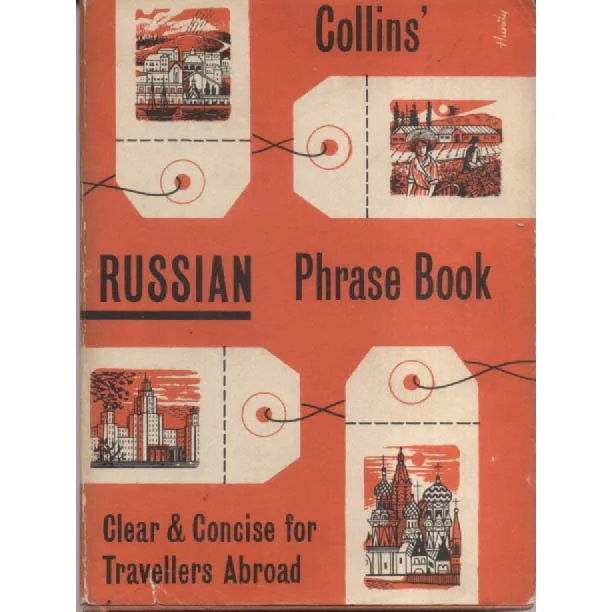
Publisher: Collins
Format: Hardback
ISBN: none
There is something wonderfully optimistic about old phrase books. They emerge from an era when international travel still possessed a faint sense of danger and glamour, and when British tourists apparently believed that carrying a pocket-sized paperback would allow them to navigate entire foreign civilisations armed only with determination, pronunciation guides and a sentence equivalent to “Where is the railway station?”
The 1962 Collins Russian Phrase Book by J.B. Foreman takes this optimism and places it directly into the middle of the Cold War.
Which makes it magnificent.
Here, in one compact paperback, is the charming idea that somewhere in the tense geopolitical atmosphere of Khrushchev-era East-West relations, an ordinary traveller might simply wander into the Soviet Union clutching a Collins phrase book and politely ask directions to the post office while the superpowers nervously pointed nuclear weapons at one another.
The timing alone gives this book enormous accidental comedy value. Published in 1962 — the same year as the Cuban Missile Crisis — this little guidebook cheerfully assumes that what the world really needed was practical assistance with ordering lunch in Russian. One half expects a chapter titled “Useful Phrases for Buying Bread Whilst Quietly Avoiding International Incident.”
And yet there is something deeply charming about that.
Inside are all the classic phrase book essentials: greetings, travel phrases, food, accommodation and attempts at polite communication rendered in careful transliteration for bewildered English speakers. Somewhere in these pages lies the linguistic equivalent of a nervous tourist attempting to ask for tea while accidentally declaring ideological allegiance to the Soviet agricultural programme.
The real joy of vintage phrase books, however, lies in the tiny cultural assumptions buried within them. Modern travel apps update instantly and blandly. Old phrase books preserve a frozen moment in history. The situations they prepare you for often reveal far more about the period than the language itself. One imagines a 1960s businessman, academic or unusually adventurous tourist practising Russian pronunciation in a smoky airport lounge while pretending not to be intimidated by global politics.
Physically, Collins phrase books from this era possess a lovely practical sturdiness. Designed for actual travel rather than decorative shelf life, they have the reassuring air of something that may genuinely have crossed borders in a coat pocket beside cigarettes, train tickets and travellers’ cheques. This particular copy being listed as Good suggests it has survived remarkably well considering the possible adventures, misunderstandings and deeply incorrect pronunciations it may have witnessed over the last sixty years.
There is also a delicious irony in the fact that modern readers are now likely to buy this less as a practical guide and more as a historical artefact. Once intended to facilitate communication across ideological divides, it now functions as a charming time capsule from an era when language learning, diplomacy and tourism all collided under the long shadow of the Cold War.
Whether you collect Soviet-era ephemera, vintage travel books, retro language guides or simply enjoy owning books that seem capable of teaching you how to ask for soup while accidentally destabilising NATO, this little Collins paperback delivers exactly the right blend of practicality, nostalgia and geopolitical absurdity.
A delightful relic from a world where even phrase books carried the faint background hum of international tension.
Keep browsing: See more Langauge books Other books by JB Foreman
